JEANNE INDRIANI

Phase 1
Some Things Are Irreversible
Experience an immersive room that challenges your perceptions of the physical and digital worlds. As you explore the space, you'll confront the harsh realities of fast fashion, a culture driven by disposability and a relentless desire for newness. The constant churn of new clothing and trends is presented as the norm, but at what cost to our environment? See for yourself as commercial products are represented as objects of nature, metaphorically destroyed with each "purchase" you make. And as you navigate the digital realm, you'll be confronted with the stark reality that there is no "undo" button in nature. The "Ctrl+Z" button serves as a powerful reminder that our actions have real-world consequences, and we must consider the impact of our consumption on the planet.


The VR Experience
As you wear the headset, you are transported to a rocky terrain overlooking the first phase of the experience. In front of you stands a large frame structure, reminiscent of a painting. Passing through it, you cross from reality into a surreal landscape where three floating eyes, defying gravity, track your movements. The path is lined with sharp-edged plants, one of which emerges from the belly of a massive, lifeless torso.
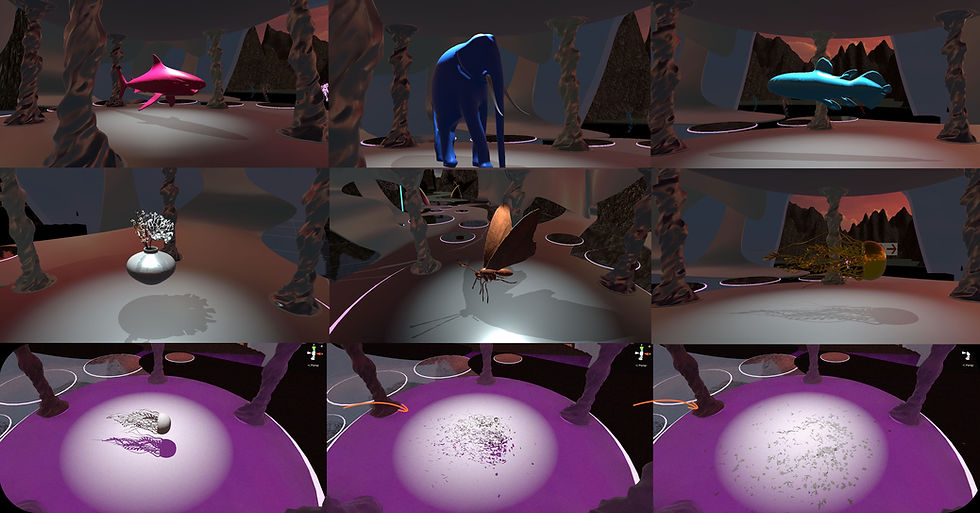
Ascending a set of stairs, you encounter a concave structure, with a trail of stepstones leading to a blue elephant. Before it lies a red button labeled "next." Each press triggers the shattering of a natural object in sequence: elephant, shark, fish, butterfly, flowers, and jellyfish. However, following the final symbol, a luminous green 'undo' button appears but remains non-functional, compelling you to proceed into the second phase.




The research started by experimenting with the different tools and modifiers available in Blender. The most interesting combination found was using the Bezier curve tool and a Bevel modifier which allows to create a cylinder-like shape that can be manipulated and changed in many ways. This combination was then used as a starting point for creating clothing designs in Blender.

In the early stages of this exploration, I decided to venture beyond the traditional fashion design software such as Clo3D and MarvelousDesigner and utilize Blender, which is not typically used for virtual garment creation. The goal was to transcend the familiar aesthetic often associated with digital fashion and discover new possibilities in terms of shape and texture by experimenting with an unconventional set of tools.
Using Blender
The space was designed with a combination of intentional decisions and intuitive choices. For example, the inclusion of water as a recurring symbol of the rising water level, the use of eyes as a recurring motif in surrealist art and the creation of a rocky terrain with pointed edges to evoke a sense of unease were all deliberate decisions. It is an intentional blend of symbolism and subconscious choices that shape the overall experience.
Building a Space in Unity


The pillar was sculpted using Blender's sculpting tool, which enables me to craft realistic wrinkles and folds, giving me complete control over the form. This tool is one of the most powerful features that Blender has to offer for the artist. However, the added details increase the total object vertices (mesh density), resulting in larger file sizes. To ensure smooth integration of the pillar into Unity for VR purposes, it was necessary to decrease the mesh density prior to export.

Finding a suitable 3D water asset that is compatible with Built-in Render Pipeline (BIRP), has underwater features, and works seamlessly on Oculus Quest 2 VR (the only headset accessible) proved to be a challenging task. During the development process, I stumbled upon a free asset from Crest Ocean System that provided the ideal visual representation of water on a 2D screen and worked properly within Unity, it also includes underwater post-processing that creates the effect of an underwater scene.
Blender Workflow:
-
Create or import the asset into Blender and set particle settings for the desired number and distribution of broken pieces.
-
Use the "explode" modifier to break the object into chunks around the particle centers
-
Apply the "cloth" modifier for fabric-like movement and animation effects, and use it as a shape key.
-
Export the file as fbx.
Unity Workflow :
-
Import fbx file into Unity
-
Create an animation for the gameobject
-
Add two keyframes, first at 0s with shape key value of 0, second at desired time with shape key value of 100
-
Create an animation controller and attach the animation.
-
Add an animator component to the gameobject and link the animation controller to it.
Building structures in Blender
All assets in the project were constructed using 3D primitive shapes in Blender. The coral dome and retail space were constructed using the plane shape and manipulating it using the subdivide modifier to give it the desired arch shape. The sky dome was constructed using a sphere mesh.


Analysis
Phase 1

The first phase of the project is inspired by Magritte, a key figure in Surrealism known for challenging perceptions of reality. His use of everyday objects in unusual contexts captures the mystery of Surrealism. This phase particularly draws from Magritte's "False Mirror," which many interpret as exploring inner vision and raising questions about perception, human nature, and the world, despite Magritte's own rejection of such interpretations. His work perfectly embodies the themes of this stage.


Torso
The human body is traditionally the foundation of fashion, the canvas for garments. However, in this digital space, I’ve taken a different approach by featuring a headless body, removing the individual’s identity. This choice highlights the detachment of the body from garments in the digital realm, where the physical form becomes insignificant. It reflects how our relationship with fashion and the body has shifted in the digital age, offering a commentary on the evolving dynamics between the two.
Eyes
Fashion reflects one’s thoughts, emotions, and identity—a visual metaphor for self-expression that spans behavior and beliefs. In this space, eyes track the audience’s movements, evoking unease and emphasizing the theme of exploring digital fashion through a surrealist lens, where the familiar meets the unknown. The frame serves as a symbol of the boundary between reality and the surreal, encouraging the audience to question the relationship between the physical and digital worlds.


Sharp Terrain and Prickly Plants
Our preference for curves and aversion to sharp, angular shapes is a deeply ingrained survival instinct. Sharp shapes trigger thoughts of danger, causing our brains to instinctively shy away from them. Research shows this preference is universal, from adults to babies, even monkeys. We are naturally drawn to the softness of curves and the flow of tapered forms. In this space, jagged, pointed edges are subtly integrated, creating a sense of unease that taps into our primal instincts. It serves as a reminder of the subconscious forces that influence our perceptions and behavior, even in everyday environments.
Imitation Sky
The towering dome serves as a metaphor for the divide between our current reality and the unknown future. It's a wall that separates us from what lies ahead, both in terms of the physical world and in terms of our personal journeys. The bright blue sky, with its associations of happiness and serenity, creates a false sense of security, masking the darkness and uncertainty that lies beyond the dome. It's a powerful symbol of how our perceptions can be deceiving and how we can be lulled into a false sense of security.
Nature Representation
This virtual experience challenges the audience's assumptions about the physical and digital worlds. By exploring the darker side of fast fashion and its environmental impact, it forces a confrontation with the harsh realities of consumerism. The relentless pursuit of newness and the ease of online shopping are symbolized by a simple button that, when pressed, breaks down the object in front of you, revealing the next—highlighting the cycle of consumption.
These commercial products are depicted as natural objects, symbolizing the destruction of nature with every "purchase." This immersive experience encourages us to question our values and reflect on the long-term consequences of our consumer habits.

Colour
Colour is a powerful tool in both surrealism and digital fashion, creating striking contrasts that evoke emotion and meaning. The use of odd and unexpected colours enhances the surreal quality, breaking conventions and challenging audience expectations. This influence is evident in the work of art director Shona Heath and her collaborations with Tim Walker. In this project, the blue elephant, pink shark, checkered fish, brown leather butterfly, grey flowers, and golden metallic jellyfish all contribute to a sense of the uncanny, provoking a feeling of unease.

Fashion and Body Pillars
The pillar sculpture is inspired by the idea of the merging of the body and garment in the digital age. The sculpture is in the shape of a ghostly torso fused with cloth, representing the loss of the body's identity in new visual technologies like film, photography, and digital fashion. Also based on Cristina Giorcelli’s “Wearing the Body over the Dress” where she proposed that clothing constitutes the language that expresses a body. They reveal social and economic status and religious or ethnic background. These are the ‘pillars’ of our identity and being in the physical world.
Irreversible Nature
This experience challenges the assumption that the world is always within our control. The red "next" button tempts you to press it, even though each press shatters a natural object. As you move through the exhibit, the message that we take resources for granted is reinforced by a non-functioning "undo" button at the end, serving as a stark reminder that our actions have lasting consequences. We can't simply undo the damage. The exhibit encourages reflection on our relationship with nature and the environmental impact of our choices.

Want to know more about each phase?
click on below